cargellio-wetlands-logo
  • Home
  • About
    • Video gallery
    • Photo Gallery
  • Services
  • Pricing
  • FAQ
  • Portfolio
  • Testimonial
  • Blog
  • Contact
  • Chapter 13 The story has to be told so here I go bold. It’s about my communications with William Plain earthight.org fame

    November 23rd, 2022

    The inspiration for my book called CargelligoWetlands available on Lachlanriverlung.com

    Billy Plains edict

    Dear Bill Plain {my letter to William Plain 8th December 1922}

    Re

    Letter to Decimillennial Australia:

    A Voice to the Nation

    This edict of yours so impressed me when I started out to publish a book of Poems and Prose on the demise of the Lachlan Valley in Central Western New South Wales.

    I have used it with acknowledgement and remuneration in both an e-book and a hard copy script. This is the link for the e-book https://books.apple.com/us/book/id6443457866

    I’m in the process of launching the hard copy.

    I have used it as an adjunct to voicing and reinforcing my opinions by way of poetry and prose.

    I did go to school with you at Saint Francis Xavier in Lake Cargelligo.

    But a  bursary took to you further on.

    Sincerely 

    Edgar Vagg

    Ps. I wrote this letter earlier to let you know what I was doing. And now I have this wonderful letter from you. The flooding in the Lachlan is easing. At its hight it broke all records. Broke levies and flooded houses. But mine was high and dry.

    {William Plain related to me sixth of December 1922}

    Ed,

    imagine my surprise to see someone making a contribution for my work on creative discussion, and in doing so providing a connection to a period aeons past when we sat in the same classroom in Lake Cargelligo, as though your gesture somehow establishes that year as a point of departure towards my lifetime of attempting to make sense of a few simple ideas, leading to my website, creativediscussion.org, arising from the insights of thousands of students, and the more recent earthsight.org, attempting to communicate with a much more recalcitrant audience of politicians and decision makers.

    Your communication leads me to update my Earthsight project, and, in grateful recognition of your reminder, I have just now added a submission to parliament, “Act on Climate”, that I made in 2020 but hadn’t yet added to earthsight.org. Many thanks.

    Looking through my records, I find this email I am now replying to, and your reading of “A Country under the Weather”, with the insightful observation of “a people who knew that no land is won or lost by war”. In today’s moment of constitutional recognition, the assertion that “no land is lost by war” is a positive reminder that Australia has not been lost by a mere 2 centuries of invader wars, not when 2 millennia, 2 decimillennia, more accurately 6 or even 10  decimillennia, have created a civilisation, an exceptional people, with a unique export, a continental civilisation based on peace (peace between peoples and peace with country), as observed by Bruce Pascoe, as well as the transformative “I am responsible for country” (today we need to add: “and planet”).

    In many of my Earthsight papers I have included a reminder from ancient wisdom that “insight is the key to creativity”, easily accessible in the simple process of Earthsight Discussion, a term I now use to refer to “Creative Discussion using Plain Pair Groups”, occasionally wondering whether this practice may unfurl the wings of the butterfly of chaos theory.  

    “Act on Climate” is my latest attempt to make a little suggestion, while “Decimillennial Australia” (earthsight.org, March 2019) indicates who we need to be listening to: the “product of wounded country”, who might even be helped by helping the larger world to actually see.

    Decimillennial Australia has probably done this before, recovering from major catastrophes; surely the separation of Tasmania and loss of coastal plains (continental shelf), what we know as the Deluge, was one, and the present ongoing Anglo deluge calls not simply for a Voice to Parliament, but even more, a “voice to the nation”, First People generated and totally independent, arising from creative interaction within multiple communities, which, who knows, might perhaps be facilitated by the “creative ideas (that) ripple out across communities and organisations” of Earthsight Discussion.

    Perhaps planetary change can start down along River Road. 

    Speaking of rivers, I hope you are not being flooded out at the moment. I’ve never driven along River Road, but using Google Earth I can imagine you may be at considerable risk. Murrin Bridge seems to be even more at risk. 

    Regards,

    Bill

    William Plain
    Emeritus Professor 
    www.creativediscussion.org & www.earthsight.org
    plain@earthsight.org

    On 30 Oct 2019, at 09:43, Edgar Vagg <edvag@me.com> wrote:

    Bill.

    I met you in Lake Cargelligo at your mothers funeral. Was impressed withCreative Discussion using Plain Pair Groups

    Bringing Wisdom into Planetary Leadership

    The drought and the severe stress created in the Lachlan Valley has brought a small group, Cargelligo Wetlands together. Conventional meetings are still being held and I will eventually bring up your ideas of plain pair groups. At the moment I have another important agenda. To release my book of poems spanning my life experiences in Lake Lake Cargelligo . I’m working on an EPUB for Apple Books of the contents. It’s poems and prose I have written and gathered together over the years . They are mainly environmental. And push the same agenda as you that humans are stupid. I have mentioned your work from 

    creative discussions.org. I can send you a link for your perusal. It’s a draft at the moment. Created on Pages on an Apple MacBook Pro laptop. I’m aiming to have an impact on citizens attitude towards global warming with its release. At First an E-book with audio readings of the poems on Apple Books and eventually a hard copy with audio included. I’m including  a sample poem in audio in a following email.

    Edgar Vagg 

    703 River Road

    Lake Cargelligo 

    NSW 

    2672

    Phone 0428981287


    Billy Plains Edict

    This his his letter to Decimillennial Australia.

    A Voice to the Nation published in Earthsight.org in March 2019

    The already established Anthropocene Mass Extinction, the 6th major extinction, for which the dominant world civilisation is responsible, is now leading us in the direction of exponential global warming and civilisation collapse, or even worse.

    We need help, the world needs help, and the urgent need for long-term global sustainability seems to point to First Peoples, and particularly the Australian indigenous civilisation, as among the few who hold the keys to the future. The very long term continuous and highly successful nature of Australian culture and land management over multiple tens of thousands of years means “Decimillennial Australia” needs to establish a “voice to the nation”, to advise on the best way to transform the totality of our civilisation so as to assure that there can be a future. There is a continuum from homo sapiens sapiens to homo stupidens stupidens which englobes whole cultures, entire continents, over centuries and millennia. Ours, the so-called ‘western civilisation’, in many key respects is at the homo stupidens stupidens end of the spectrum.

    The Australian decimillennial culture in its historical dimension is undoubtedly at the homo sapiens sapiens end. I am inviting those in the indigenous community with ‘access’, to reach back beyond 1788, beyond the two centuries of destruction and belittlement, back into the depths of that culture, and bring forth the knowledge, the wisdom, the essence of 100,000 years of an ever-developing culture, community and 19responsibility for the earth. Today, this century, that knowledge may well be the key to the future, the key to there being a future. The new Australian culture of two centuries, along with that of much of the present world, is destroying our planet. That’s the meaning of the term, ‘the Anthropocene mass extinction’, which has its origins with the industrial revolution – about the time the doctrine of Terra Nullius arrived on Australian shores. 

    We don’t realise what we have done, and don’t know how to change. But our problem is now the problem of all peoples, those who have caused the present situation, as well as those who have always worked to contain the damage and respect the planet. It is to be hoped that the most ancient of those wisdom cultures, perhaps the most peaceful and the most responsible, can now become the guide that can advise our leaders and our people – and find ways to lead them to listen and be informed. Looking at the world today, much of the planet is the detritus of the brutality of the Western search for domination and conquest – ever perfected by today’s corporatocracy, financeocracy and oligarchy. The Earth herself is now looking to you, to the people 21 who have tended the earth for 100,000 years, spanning geological catastrophes that today we seek to ignore, while closing our eyes to similar ecological catastrophes we have already created in ‘our’ epoch of the Anthropocene. The 10 millennia that has seen the development of what is now the ‘western civilisation’ that dominates, destroys and is slowly reducing to detritus the major part of the entire world population and its natural diversity evidently do not carry the seeds of wisdom we are desperately in need of today. On the contrary, the 10 decimillennia of Australian civilisation, the peoples who eschewed the deceptive riches of quantity for the wealth of quality, can present the essential understanding that can lead this country, and the entire planet, to a new world, a world of people and planet, rather than a world of profit and power for the few.

    We need your assistance to avoid a futurecide that could be worse than the Permian Mass Extinction. The dominant world culture does not have the answer. Any attempt to avoid the risk of exponential warming while using the same technologies and structures that caused it is doomed to failure. We need something new, something ancient, the wisdom and expert knowledge that guided the most successful and sustainable culture and land management of all time, with its respect for life, for community, for country, for planet. There we may find a guarantee of a long-term future for our grandchildren and their grandchildren, and beyond. This process of creating a new world, a world with its origins in so many and varied traditions of sustainable agriculture and supportive communities around the world, would certainly make judicious use of the multitude of non-impactual aspects of the present world; much of our science and technology and culture can be compatible with a ‘planet with a future’. We also need to sustain a deep confidence in the evolutionary direction of the living planet over 4 billion years of dynamic homeostasis, despite the 5 major extinction events to date. We have now initiated the 6th, the first ever where a single species is uniquely responsible. But because we have caused it, through a species-wide reevaluation of our role in the ecosphere, we can initiate a process of fundamental and radical change that can make the world a much better place to live in, for all, and at the same time guarantee a future, for all. The threat of global warming can dissipate by quickly – very quickly – eliminating the causes of the Anthropocene extinction: the excessive human footprint and the carbon overload as well as the massive exploitation of both planetary and human resources.

    To do this we certainly need to reevaluate the type of society and economy, the type of leadership, that have developed over centuries, if not longer. The important work of identifying and promulgating the values and the ways-of-being that can help us to draw back from the brink is the most urgent challenge our species has faced.

    It seems this type of world that can guarantee that there will be a future has already existed, perhaps in many parts of the world, but on a very long-term continuous basis it has flourished most importantly in Australia. Today such a world desperately needs to be imagined, guided and nurtured into existence by those who have access in the not so distant past to a living culture that can inform our world today. By itself, our world seems incapable of achieving this.

    Regards,

    William Plain

    Email: plain@earthsight.org

    www.creativediscussion.org & www.earthsight.org



    cargellio-wetlands-logo

  • Chapter 14 And amazing library of poems in prose

    November 23rd, 2022

    Wow I got hold of this book. An amazing library of poems and prose.

    Salvaged them from the wreckage of the Anthropogenic Era error. From the black box of the wreckage. Out in barren back blocks of the scorched continent. Got them. Now. Hurry, last rocket to the moon space port. Smuggled the box recording through. The alien custom officials. cajoled, bought. Now. Much to do Think outside the box , I’ve landed on the dark side of the moon No radio signals just dust and rocks 
    Tucked up in my life support cocoon. I’ll go to work soon I’m in the dark as to what approach . Exposing this. I could be liable. Nah, not a subject I have to broach I swear on the bible. They are for humanity’s clawback, got to be told. So here I go, bold 

    https://books.apple.com/au/book/cargelligowetlands-version-6/id6443457866

    cargellio-wetlands-logo
  • Chapter 15 William Plains Edict

    November 22nd, 2022

    Billy Plains edict

    A voice to the nation The already established Anthropocene Mass Extinction, the 6th major extinction, for which the dominant world civilisation is responsible, is now leading us in the direction of exponential global warming and civilisation collapse, or even worse.

    We need help, the world needs help, and the urgent need for long-term global sustainability seems to point to First Peoples, and particularly the Australian indigenous civilisation, as among the few who hold the keys to the future. The very long term continuous and highly successful nature of Australian culture and land management over multiple tens of thousands of years means “Decimillennial Australia” needs to establish a “voice to the nation”, to advise on the best way to transform the totality of our civilisation so as to assure that there can be a future. There is a continuum from homo sapiens sapiens to homo stupidens stupidens which englobes whole cultures, entire continents, over centuries and millennia. Ours, the so-called ‘western civilisation’, in many key respects is at the homo stupidens stupidens end of the spectrum.

    The Australian decimillennial culture in its historical dimension is undoubtedly at the homo sapiens sapiens end. I am inviting those in the indigenous community with ‘access’, to reach back beyond 1788, beyond the two centuries of destruction and belittlement, back into the depths of that culture, and bring forth the knowledge, the wisdom, the essence of 100,000 years of an ever-developing culture, community and 19responsibility for the earth. Today, this century, that knowledge may well be the key to the future, the key to there being a future. The new Australian culture of two centuries, along with that of much of the present world, is destroying our planet. That’s the meaning of the term, ‘the Anthropocene mass extinction’, which has its origins with the industrial revolution – about the time the doctrine of Terra Nullius arrived on Australian shores. 

    We don’t realise what we have done, and don’t know how to change. But our problem is now the problem of all peoples, those who have caused the present situation, as well as those who have always worked to contain the damage and respect the planet. It is to be hoped that the most ancient of those wisdom cultures, perhaps the most peaceful and the most responsible, can now become the guide that can advise our leaders and our people – and find ways to lead them to listen and be informed. Looking at the world today, much of the planet is the detritus of the brutality of the Western search for domination and conquest – ever perfected by today’s corporatocracy, financeocracy and oligarchy. The Earth herself is now looking to you, to the people 21 who have tended the earth for 100,000 years, spanning geological catastrophes that today we seek to ignore, while closing our eyes to similar ecological catastrophes we have already created in ‘our’ epoch of the Anthropocene. The 10 millennia that has seen the development of what is now the ‘western civilisation’ that dominates, destroys and is slowly reducing to detritus the major part of the entire world population and its natural diversity evidently do not carry the seeds of wisdom we are desperately in need of today. On the contrary, the 10 decimillennia of Australian civilisation, the peoples who eschewed the deceptive riches of quantity for the wealth of quality, can present the essential understanding that can lead this country, and the entire planet, to a new world, a world of people and planet, rather than a world of profit and power for the few.

    We need your assistance to avoid a futurecide that could be worse than the Permian Mass Extinction. The dominant world culture does not have the answer. Any attempt to avoid the risk of exponential warming while using the same technologies and structures that caused it is doomed to failure. We need something new, something ancient, the wisdom and expert knowledge that guided the most successful and sustainable culture and land management of all time, with its respect for life, for community, for country, for planet. There we may find a guarantee of a long-term future for our grandchildren and their grandchildren, and beyond. This process of creating a new world, a world with its origins in so many and varied traditions of sustainable agriculture and supportive communities around the world, would certainly make judicious use of the multitude of non-impactual aspects of the present world; much of our science and technology and culture can be compatible with a ‘planet with a future’. We also need to sustain a deep confidence in the evolutionary direction of the living planet over 4 billion years of dynamic homeostasis, despite the 5 major extinction events to date. We have now initiated the 6th, the first ever where a single species is uniquely responsible. But because we have caused it, through a species-wide reevaluation of our role in the ecosphere, we can initiate a process of fundamental and radical change that can make the world a much better place to live in, for all, and at the same time guarantee a future, for all. The threat of global warming can dissipate by quickly – very quickly – eliminating the causes of the Anthropocene extinction: the excessive human footprint and the carbon overload as well as the massive exploitation of both planetary and human resources.

    To do this we certainly need to reevaluate the type of society and economy, the type of leadership, that have developed over centuries, if not longer. The important work of identifying and promulgating the values and the ways-of-being that can help us to draw back from the brink is the most urgent challenge our species has faced.

    It seems this type of world that can guarantee that there will be a future has already existed, perhaps in many parts of the world, but on a very long-term continuous basis it has flourished most importantly in Australia. Today such a world desperately needs to be imagined, guided and nurtured into existence by those who have access in the not so distant past to a living culture that can inform our world today. By itself, our world seems incapable of achieving this.

    Regards,

    William Plain

    Email: plain@earthsight.org

    www.creativediscussion.org & www.earthsight.org


    cargellio-wetlands-logo
  • Chapter 16 Oxley at Lake Cargelligo 

    March 28th, 2021

    July 23.—1817

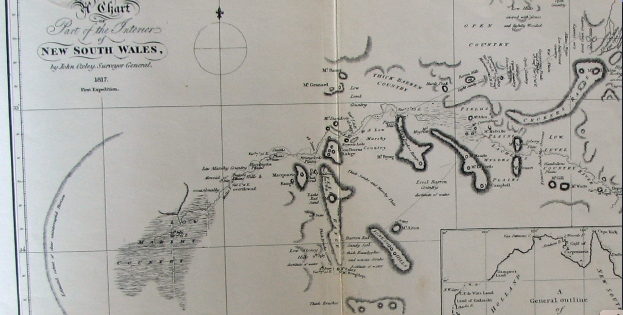
    Extracts from oxley’s diary as he passed through Lake cargelligo. Extracts from his observations made in Guttenberg Press publication of his daily diaries as he came down and up the Lachlan. in 1817.

    Oxleys map is a part sketch of the area bounded by the Northys Hills in the west and Sansons Hills in the east. The Lachlan River runs from the north-east to the west. Smalls Lake and Lake Cargelligo are circled in. Smalls Lake is Campbells Lake and Lake Cargelligo is Regents Lake. Northys Hills is the Goulburn Range. Mount Bing is Sansons Hills to the east of the Lachlan Range. Notice he has called all that area between “low marshy country”.

    I’m posting this to reinforce the fact oh how depleted Lachlan Valley has become after colonisation.

    Oxleys diary July 23, 1817 :

    The river had fallen a little during the night. At nine o’clock we again set forward: the country became extremely low and marshy, far more so than any we had passed over east of Macquarie’s Range.(Lachlan) These marshes extended so far southerly that to have gone round them would have led us far from our purposed course without answering any useful purpose, and although we judged that at first they might not extend above three or four miles back, yet we soon had reason to change that opinion. The river had led us upon a general course nearly east about six miles, when about half a mile from the bank southerly, a very extensive lake was formed, extending about east-south-east and west-north-west from three to four miles, and being about a mile and a half wide. Excepting the sheet of water on the north side near the termination of the stream, this was the only one we had seen that could justly be entitled to the denomination of lake. We crossed over a low wet swamp, by which its overflowings are doubtless re-conveyed to the river. This lake was joined to another more easterly, but much smaller. We could not form any correct judgment how far the marshy ground extended south-east of it; but the country was low and level as far as Mount Byng, and a low range extended north-easterly from it. We now kept the banks of the stream, till at the tenth mile we ascended a small hill a mile south of it, from which Mount Byng(a hill somewhere between Lake Cargelligo and Tullibigeal) bore N. 12. E. Close under the hill ran a considerable branch of the river, which certainly supplied the lakes and lower grounds with water; on the other side of this arm, the country was low, and apparently marshy as far as we could see. On examination I found it would be extremely difficult to cross this branch, as the water was too shallow to swim the horses over, and the ground so soft that they could not approach the banks within several yards. I therefore determined to get upon the river nearly where this branch separated from it, and endeavour to construct a bridge, by which we might convey the provisions and baggage over: as to the horses, they could easily swim across.

    The course of the river during the day had been nearly due east, but from the separation of the branch it seemed to take a more northerly direction; the banks were very low, and never exceeded five feet from the water. Occasional points of land somewhat more elevated than the general surface would of course make them in Places a little higher; but we could not discover any marks which denoted a greater rise than six feet, or six feet six inches, above the present level. When we halted in the evening, the stream was running with great rapidity. The water did not appear to have either risen or fallen during the day; but all the trees which would have best answered our purposes were now several feet in the water. We had however no alternative but to cross somewhere in this neighbourhood, as we were fearful of entangling ourselves in marshy ground by proceeding farther up this bank; and to attempt to penetrate, or even to round, the marshes to the southward, (if it were practicable,) would take up more time (without being of any service) than we could spare. Experience had made us too well acquainted with the nature of these marshes to run any needless risks; and we had besides great hopes that we should find better travelling to the northward, which as the river seemed inclined to come from that point would also be a great convenience to us, as I did not purpose to quit its banks as long as it continued to run any thing north of east.

    As to the soil and general description of country passed over this day, the low-lands were all swamps covered with atriplex bushes, and where the land was a little more elevated, the soil was sandy and barren, covered with acacias, dodonaeae, small cypresses and dwarf box-trees. Our course was E. 4. N. 6¾ miles; but by the windings of the river, we had measured nearly 12 miles. The lake I named Campbell Lake (Smalls Lake), in honour of Mrs. Macquarie’s family name.

    This Google Earth screenshot is the present day aerial view of the country Oxley is describing in his daily diaries of the 23rd and 24th of July 1817

    July 24.—At day-light we attempted to construct our bridge near to the place where we were encamped, but as fast as the trees were felled they were swept away by the rapidity of the current; the breadth on an average being now, by reason of the flood, nearly sixty feet, and the trees on the immediate or proper banks being several feet in the water: we were therefore obliged to fell trees farther inland, and these, as before remarked, were swept away, falling short of the land on the opposite side.

    All our attempts to construct a bridge during the day were fruitless, as the flood was too violent to allow the trees to take firm hold: in searching the banks of the stream for a proper place for our purpose, an arm nearly as large as the main branch up which we had travelled was discovered about a mile down the stream on the north side; it ran to the north-north-west, and then apparently trended more westerly. Thus is this vast body of water, all originating in the Eastern or Blue Mountains, conveyed over these extensive marshes, rendering uninhabitable a tract which they might reasonably be expected to fertilize.

    Finding that in the present high state of the water we could not succeed in crossing the river, at least near our present station, and that if we returned lower down we should experience a farther difficulty in crossing the north-west arm recently seen, it was judged best to try if we could get over the branch on the south side, and swim the horses over in the main stream near the mouth of the branch. We could not, however, find any tree on this side that would reach across; although it was quite dark before we gave over the attempt for the night.

    Oxley’s own map of his journey down the Lachlan 1817. The journey began at Cowra. He was blocked at Gemalong near Forbes on his way down. Was heading back to the sea in the south to hitch a ride back to Sydney. Turned around again near the present day Griffith went north to find Lachlan again. Proceeded down stream to Booligal then returned again past Lake Cargelligo. Crossed the river near Kiacatoo went back to the Macquarie and made his way back to Bathurst from there.

    July 25.—Every means was again employed in constructing the bridge over the south-west branch. The stream had fallen but a few inches, and continues to fall too slowly to permit us to entertain any hopes of crossing it in this vicinity.

    Our bridge was finished by one o’clock, but it being too late to cross the horses and baggage this evening, I went in company with Byrne on horseback to view the country to the southward. After going about two miles and a quarter south of the tent, we were most agreeably surprised with the sight of a very fine lake( Lake Cargelligo); we rode down to its shores, which on this side were hard and sandy beaches. On the south side the shores were bolder, being red clay cliffs. We now found that the creek or arm which I had supposed to be the source whence Campbell Lake( Smalls Lake) was supplied, had not any communication with it, but supplied the lake we now saw: a low ridge of hills, bare of trees except small cypresses in clumps, lying between the two lakes, which were distant from each other two or three miles. Finding I might obtain a better view by going to the point of these bare hills about five miles westward, I rode thither along the margin of the lake, but quitted it to ascend the hill, which was about two miles and a half from it. The hill was but low in comparison with Goulburn’s Range. Northeys HIlls) and other hills in the vicinity, but was sufficiently elevated to afford me the most varied and noble prospect I had seen in New South Wales The expanse of water was too large and winding to be seen in one point of view, but it broke in large sheets from east to west for upwards of six miles; its medium breadth being from two and a half to three miles: it was bounded six or seven miles from its eastern extremity by a low range of hills connected with Mount Byng (Sansons Hills), and from the dark broken woody appearance of the country in that direction, I felt assured that the stream came from a more northerly quarter. To the westward was Goulburn’s Range,(Northeys Hills) distant about five or six miles; its bold rocky peaks of lofty elevation forming a striking contrast to the dead level of the country southerly, in which however Mount Aiton(perhaps IllawongHills) appeared like a blue speck on the horizon. To the northward was Mount Granard, the highest of a very elevated range, it having been seen at a distance of seventy-two miles from Mount Aiton; and to the north-north-east were extensive open flats; in one place, bearing N. 17. E., I thought I could distinguish water. Between the hill on which I stood and the stream, Campbell Lake (Smalls Lake) wound along the plain, but its width did not allow it to be so conspicuously seen as the present one. To the south-east and round to the north-east the country was covered with dark foliage of the eucalyptus, intermixed with the cypress; whilst to the south-west, as far as the base of Goulburn’s Range (Northeys hills), it was more open, with gentle hills clothed with a few small cypresses. These hills were rocky and barren, the lower grounds a red loamy clay; but the intermingled light and shade formed by the different description of trees and shrubs, the hills, but above all, the noble lake before me, gave a character to the scenery highly picturesque and pleasing.

    From this eminence I took the following bearings to objects connected in the survey, viz.The highest point of Goulburn’s Range N. 225 degrees distance 5 or 6

    miles.

    Do.             Do.  Mount Aiton         143

    Table Hill                               116

    Mount Byng                               114

    West extreme of the lake N. 106. 30. distance 2½ miles.

    East       Do.       Do. N.  65.     distance 5 or 6 miles

    Highest point of Mount Granard          N. 341

    Extremes of extensive flats from N. 346½ to N. 10. distance

         12 or 14 miles,

←Previous Page
1 2 3

© 2022 Cargellio Wetlands

Website Built By WordPress.com


Loading Comments...
 

    • Subscribe Subscribed
      • CargelligoWetlands
      • Already have a WordPress.com account? Log in now.
      • CargelligoWetlands
      • Subscribe Subscribed
      • Sign up
      • Log in
      • Report this content
      • View site in Reader
      • Manage subscriptions
      • Collapse this bar