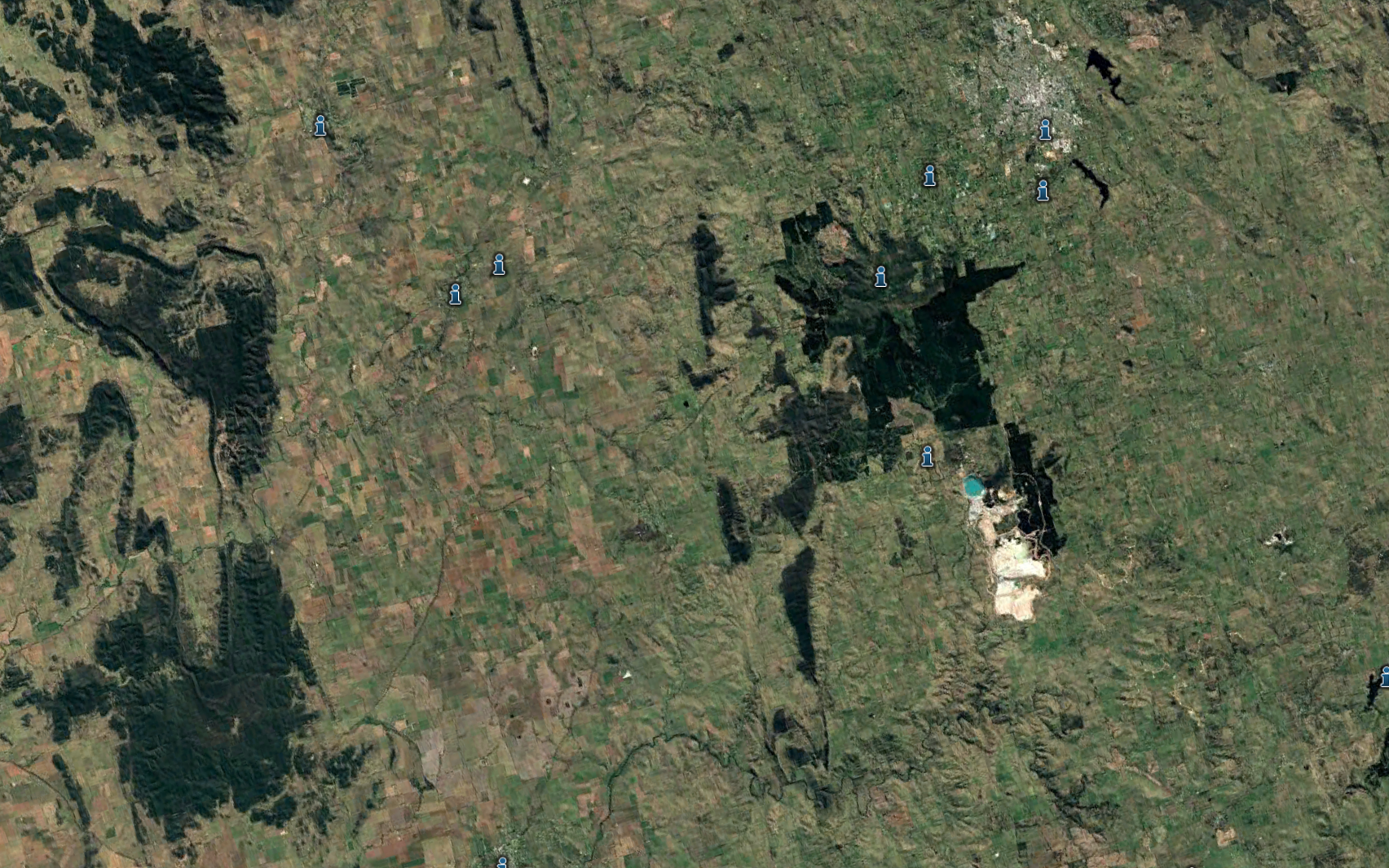
Mount Canoblas the centre of a drainage catchment I visited and videoed in 2010 and pointed out the problems that would eventually result in a disastrous flood in 2022
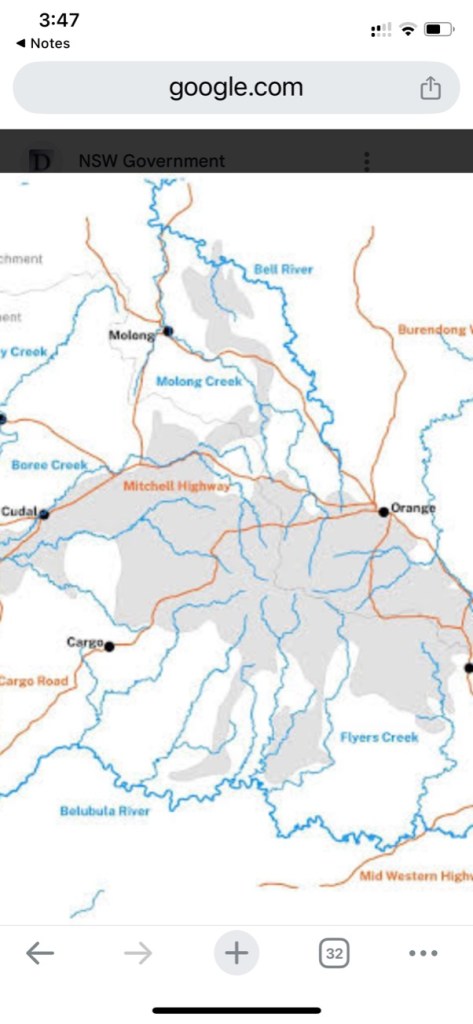
Mount Canobolas is the centre of all the streams radiating out from this map. Mount Canobolas volcanic soils a very porous and surface water is collected underground in the fractured rock aquifers covering this entire area.
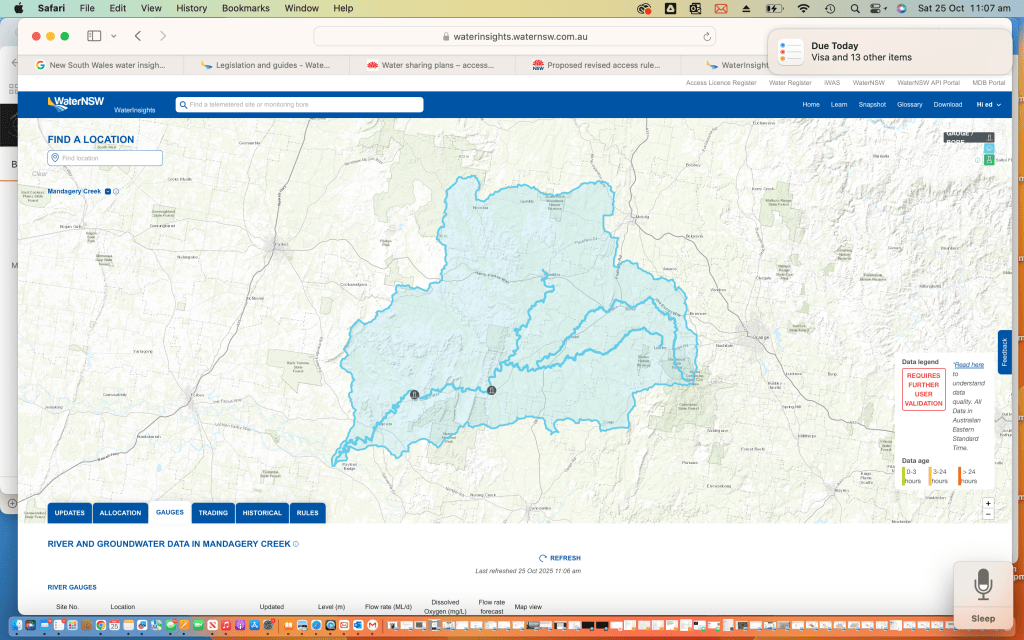
The blue shaded area on this map which is the Mandagery Creek catchment contains some of those streams radiating out from Mount Canobolas potentially carrying water right to the Lachlan River below Eugowra
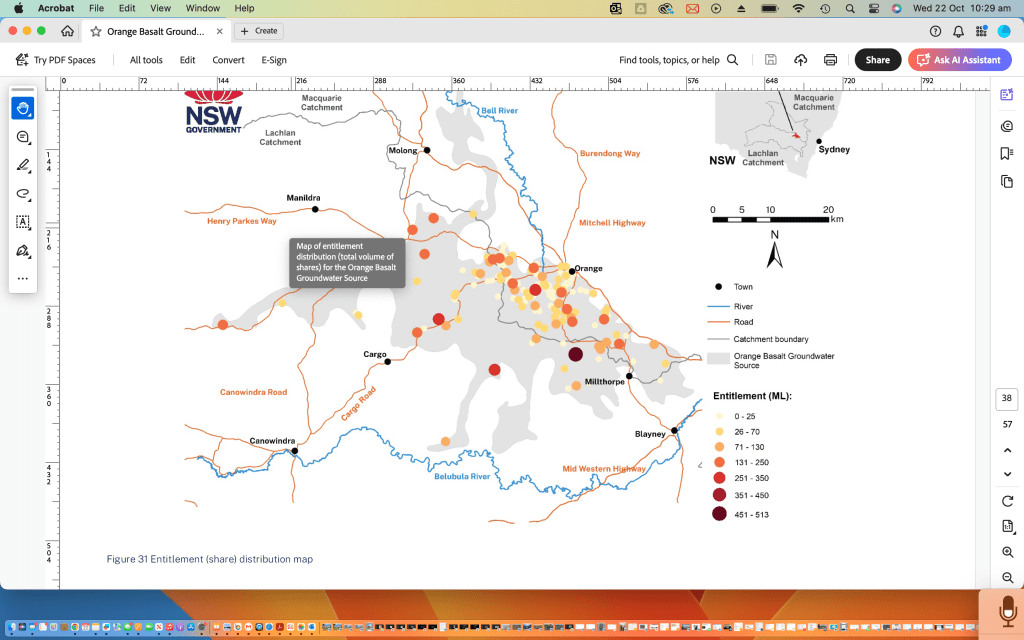
Map of entitlement distribution (total volume of shares) for the orange basalt ground water source. This water source is adjacent to the Mandagery Creek water source.
I wrote the following poem. I videoed the above video. Recorded the above audio all in 2010. Pointing out the problems of overuse of our vital ecsystems 15 years ago.

 Google earth doesn't lie

It's shows the earth from the sky
.
 The Upper Lachlan catchment isn't flat

 we can be sure of that.

What I see. No tree,

only water carved wrinkles
.
Free to carve deeper

. Run water run and scour.

It's a joke that you can no more soak

Look, look down at the manhandled Mandagery


It's a shame.

It's just a drain.

To speed the rain.

 Sudden storm like an express train

. Winds it's way to a salty end on the Lachlan plain.

We've got the brains to slow the rains
.
 And there are some good souls go to pains

. As a bystander I am shocked

  by the stocks impact.

Piecemeal it won't heal.

How much floggen and delog'n
.
How much pug'n and bog'n.

Join together.

 Make a chain to restrain the flow
.
 A chain of land owners to recreate the chain of ponds

. A chain of resistance to stock
.
  A virtual lock on vulnerable land.

 Collar the cattle.

Shock the stock of that block.

Give them some other till it can recover

. GPS not only a factor in steering ya tractor

. Steers the stock.

 They yield to a virtual field.
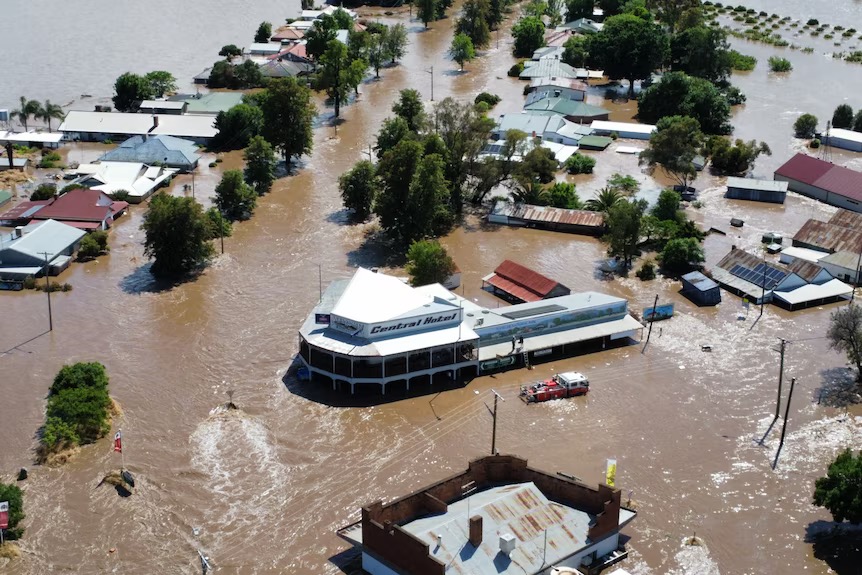
photo curtesy ABC news.
Eugowra. Main Street during the 2022 floods.
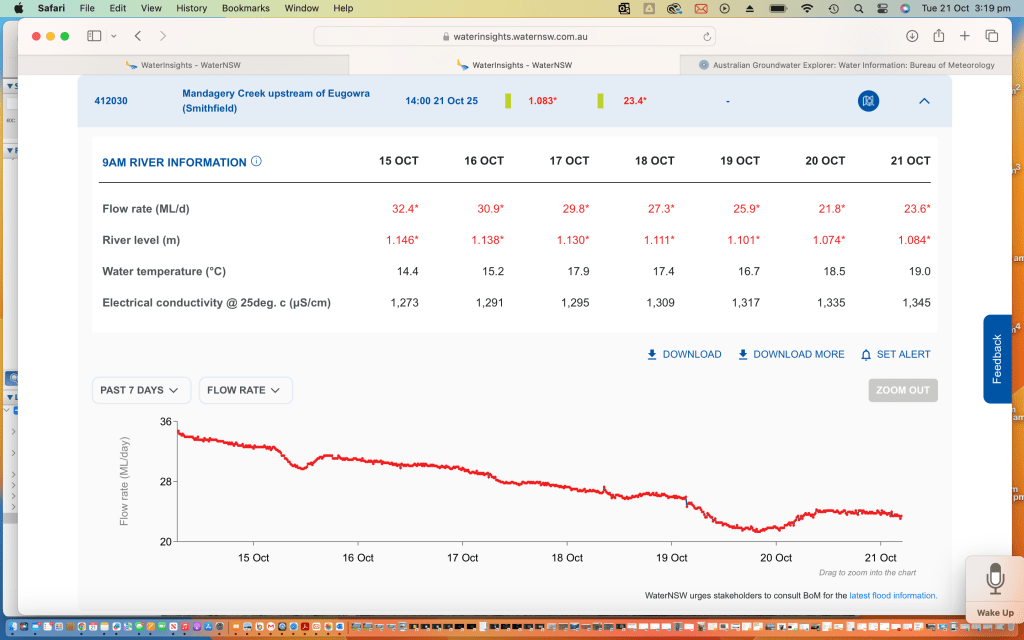
look at the monitor bores around Mount Canobolas groundwater catchment
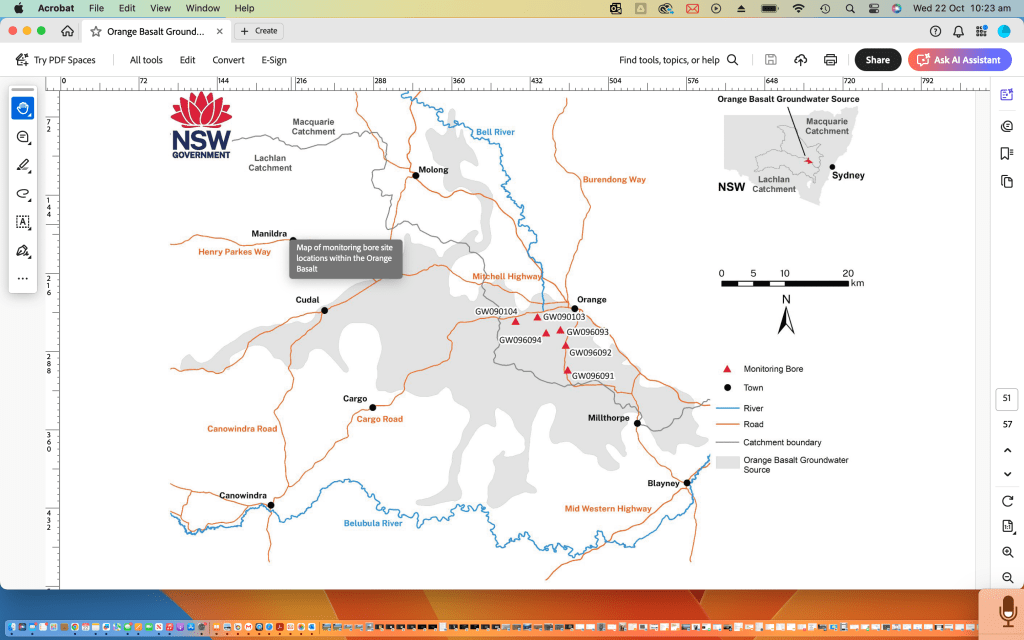
Look at the extent of the catchment called Mount Canobolas groundwater
All of the lachlan catchment surface water sources
Extraction rates from bores around Mount Canobolas ground water source
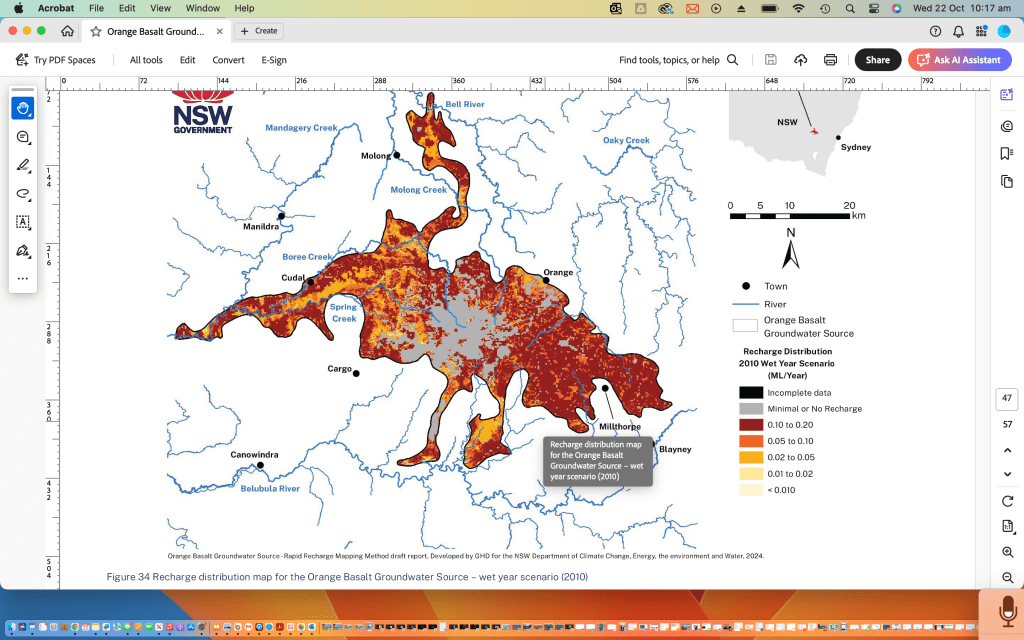
Recharge of Canobolas ground water sources in good years
Recharge of Canobolas ground water sources in poor years
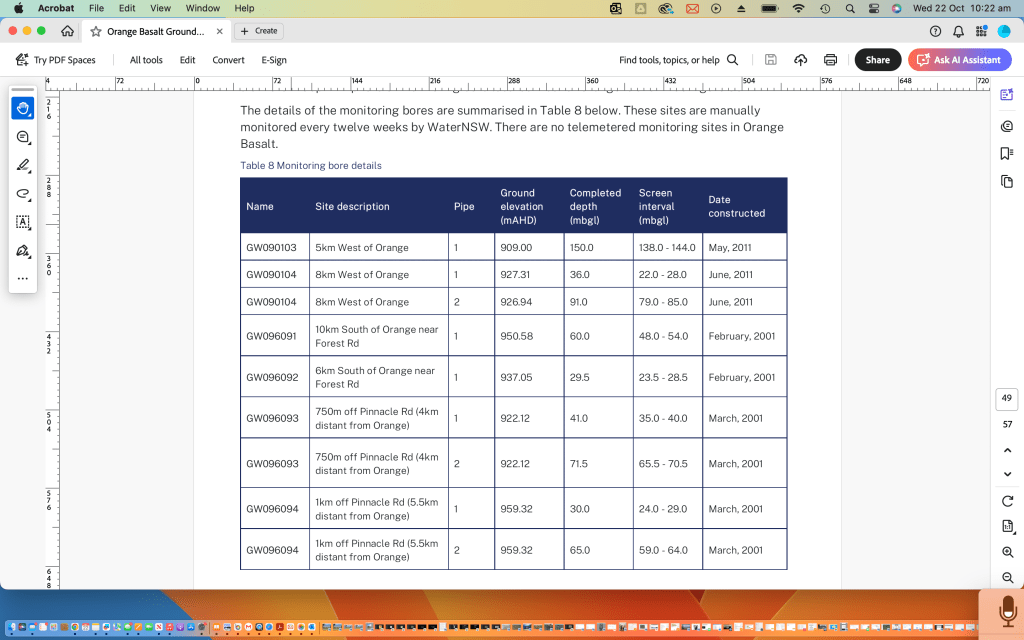
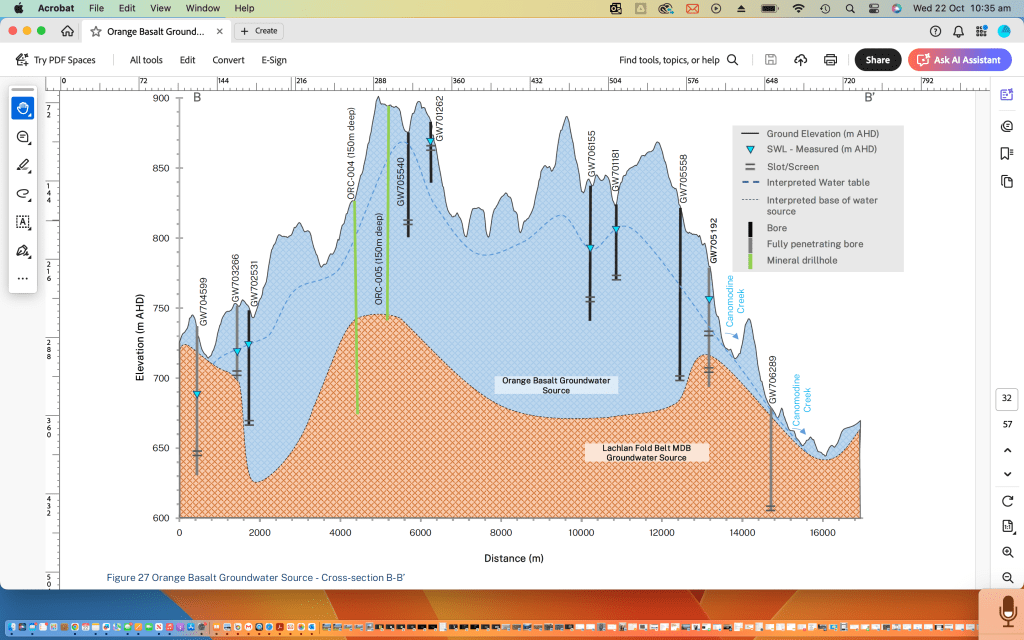
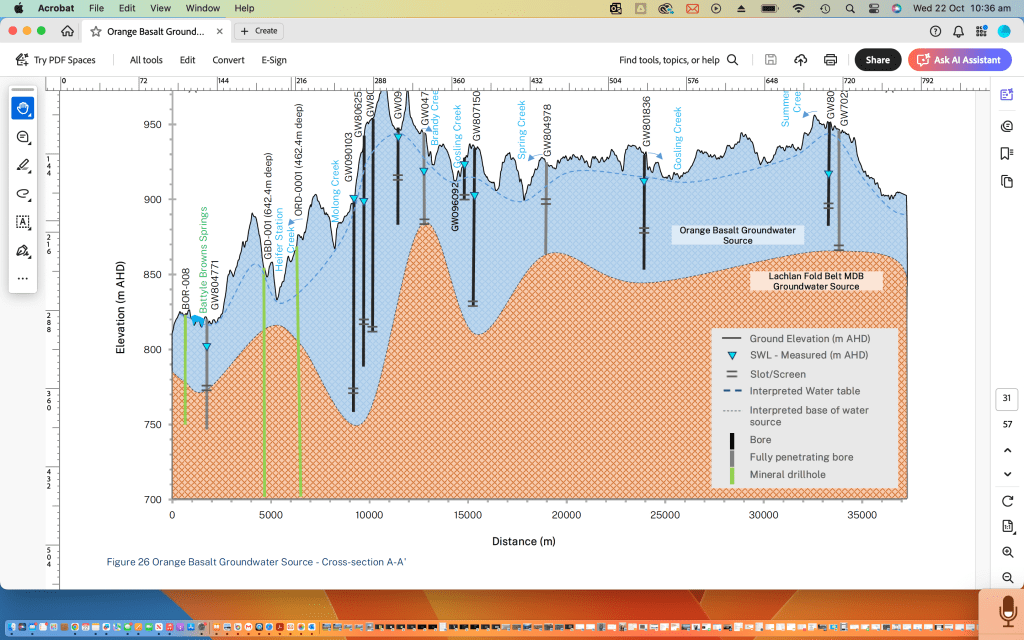
Bores in the Canobolas ground water source and also the Lachlan fold belt fractured rock water source
More bores in the Canobolas groundwater source
I acknowledge that use of data from Google Earth and the New South Wales government websites
THE RESURRECTION OF LAKE CARGELLIGO. It had been dry for awhile. This video was taken on fifth of February 2010 as rains started to fall.
by:
Edgar T. Vagg

Eddie's editing take.

I watch a scene on the screen.

A resurrection of a lake.

On the third month it rose again from the dead.

The camera zoomed in on the distant shoreline.

I'm taken aback with the flood of emotion at the flood of water and its motion. Taken back to my childhood playground. Oh! Wading summers, willow summers, white-capped waves wash over wallowing wags. Whooping and wailing.

Yesteryear as sharp as the smell of weed and water and waders, pardalot and coots and water rat under willow roots.

Show me more for my memory store.

The camera zooms the placid waters.

Rowing and bailing, becalmed.

Sailing and bailing, gibeing and leaning and reaching in a choppy southwester. Shocked by the cool wet spray on a scorching summer's day.

Now shocked by the power of emotion.

An old friend has risen from the dead. Resurrected by moisture from the distant ocean.

Lake Cargelligo
Lake Cargelligo risen from the dead on the 15th February 2010
This poem was written and recited about 2013. It was posted to YouTube at that time. It can be found under my YouTube name Edvagg
We are all on the blunder bus.
All brandishing a blunderbuss a blunderbuss. Blowing out our brains to the strains of "We shall overcome" There's a blunderbuss of regulations
Coming from nervous nations Be aware, cosmic care Is there The force that sets the course The unconscious cosmic influence Surges through humanity. Devoid of vanity Everybody cheers the blundering bus.
There's very few jeers for the blundering bus Science drives the blundering bus Its an atomic powered blunderbuss Not the gun-powdered one of old Ignorance is onboard the blundering bus Parliamentary Acts are a blunderbuss of regulations They're coming from nervous nations All designed to deploy and destroy opponents that annoy Don't despair, cosmic care Is there. The force that sets the course The unconscious cosmic course Surging through humanity. Devoid of vanity Sages throughout the ages have written and still do With this power of intuition often thought taboo, pages and pages of music and verse From their pen to you Steering us from the god of reason Throughout every season.
Here, from my pen to you
without further ado:
I'm cold in this cocoon of warmth. I'm deflated in this pumped up world. I'm not worshipping the god of reason I'm considered unreasonable. I'm looking in a cave but finding no monsters. I'm looking to the mountains and see no gods. The ancient spirits have abandoned us disbelievers. No ancient altars of sacrifice to appease the gods. But there are sacrifices. With a stroke of a pen more powerful than a bolt of lightning a rainforest is sacrificed to the god of reason.
There's no native gods to pull us into line. To smote us with plagues. To point the bone at our unearthly throne. They have been disposed of Dispossessed. Dismissed from their custodial duties. There's great fears for the land they nurtured well The land despairs Rainfall repairs.
With the Gods gifts of bounteous rain What do we do? Inflict more pain What do we do? Gain more gain For the gravy train Its reasonable to run with the gods gifts Its reasonable to run down rangelands Its reasonable to run with excesses Run a race horse Run off to the races Rearrange your faces Run off the rails
Now, out of their twiggy forest pop holes. Comes the afflicted addicted depicted as lost souls The God of reason,* our new mythical monster In the form of a blind mole surges forth Emerges from the Underground it haunts Usurps these lost souls primitive urges And begins its scourges . Like gaunt emaciated sheep they are sacrificed Captured for the chop Drained of every drop of godliness Resort to splurges depraved urges. Reasonableness resurges No hunt, no hounds. Nature is outward bound In the automated towns. Insulated from the dust storms, norms as the earth warms.
Anarchy abounds in the surrounds. Those with compassion are lashed for a lash'n, leaded or beheaded. Their captors kill at will to satisfy an ill -gotten notion that they are the chosen ones with guns. The appointed, anointed sons of reason Commandos commanding in the killing season.
Holy cow! Stop it now! Bond yourself with the benevolent gods. Reconnect with their world, the sod. They're not unreachable. They're are unpreachable. I implore. Adore Restore Their sanctuary, the savannahs, the woodlands, the rivers And the oh so twiggy forests and Twiggy Forrest's plan for unemployed man** The plan, to have everyone work again with dignity. No mentally degraded. No poor bastard parading jaded In prisons yard. Hard drugs Too hard No poor unfortunate.
The Mythical monsters of old who once kept civilisation from shitting in its own nest, are no more. They have been kicked out the door. But we have created a new one. The devils son
The new Mythic God of Reason conquers nature. Changes the season. Extinguishes species. Lives in its own fecies. And ohhh Brother, rapes its own mother. To man its a mental menace. Drugs his panacea. Its menacing, Subjugating, Subordinating and decimating Mother Earth for all its worth. She has taken a stance, Led us on a merry dance. Thrown her humans out of tilter. They smoke with no filter, Create strife. Live life as if there's no tomorrow, Borrow From the future. If you stand in the way of their loot they'll shoot ya.68 Why, why Do the non humans cry? " human nature we hate ya." Well. we have placed ourselves above them,
We don't love them. We have bared the plains And stopped the rains. No more do our rivers deliver The life giver water as they orta. Flood plain gums we plunder. Their death cracks like thunder. Startles the cockatoo community, Trying to maintain its unity, While we march on seemingly free of impunity. But. We are not so, see, the cracks are starting to show. Watch the wind blow, Desiccating the treeless land, Shifting sand, Temperatures climbing, Species declining. Now the first living thing Throws its hat in the ring. The simple cell Is giving us hell, Bacteria and virus Defy us. Think you can kill us with your chemical stew says Giardia the harder ya try The more we defy. We are one with nature, not one above With no love. She is vulnerable. But when push come to shove, She has a winner They eat us for dinner. The virus Defy us She has these little ones, They have big guns, Fighting on a hidden front A guerrilla stunt. They are winning, Thinning Us. Multiple resistance Ensures their persistence. They frustrate those who think they can dominate, Annihilate. Panicky people are just as liable To re-interperate the bible. The lord told moses on the mountain With the mob below idolising. Take this tablet and you will be on the path to ecstasy.
The bibles been skewed. The message has been misconstrued With modern man As it can. Now we are taking ecstasy tablets, This wandering, aimless lost band still idolising.
Reference: **Article by Jared Owens in the Australian 31st July 2014 "Twiggy Forrest plan" * Youtube clip "Approaching the unconscious" by C.arl Yung
Delivering resilient water resources for all water users in the Belubula Valley.
A 20-year Macquarie-Castlereagh region-specific strategy to improve the security and certainty of our water resources.The department’s Water Group is investigating options aligned with the Lachlan Regional Water Strategy and the Macquarie-Castlereagh Regional Water Strategy. These 4 options include: (The department is working with WaterNSW and Central Tablelands Water on this project.)
a new pipeline between Lake Rowlands Dam and Carcoar Dam to transfer up to 2 gigalitres of water per year, capturing spills and boosting supply
raising the Lake Rowlands Dam wall to increase storage from 4.5 gigalitres to 8 gigalitres
building a new dam 2.5 kilometres downstream of Lake Rowlands
connecting the Belubula and Macquarie valleys through an interregional pipeline.
a new pipeline between Lake Rowlands Dam and Carcoar Dam to transfer up to 2 gigalitres of water per year, capturing spills and boosting supply
raising the Lake Rowlands Dam wall to increase storage from 4.5 gigalitres to 8 gigalitres
building a new dam 2.5 kilometres downstream of Lake Rowlands
connecting the Belubula and Macquarie valleys through an interregional pipeline.
Note: New South Wales Water has lots of information on these projects. Initially they have presented the four options from the Belubula Project as drought proofing the Belubula. But the last option commencing “connecting” in both projects gives this notion away.
It looks like it’s mainly designed to bolster the Macquarie- Castlereagh Project
It’s not about profit and power; it’s about the people and our precious planet! Join the exhilarating journey of the Plain Train! Puffing Billy, Brilliant Billy, Brainy Billy—schooled at SFX Lake Cargelligo and soaring to the heights of the world’s greatest universities! Now, let’s passionately rally together and awaken the realization that we, as humans, need to rise above our ignorance!
R’esum’e-William Plain. History
2011 Emeritus Professor, Nagoya University of Foreign Studies
1998-2011 Nagoya University of Foreign Studies, professor, Educational Linguistics
1993–98 University of Tsukuba, Japan, professor, Educational Linguistics
1990-93 Niigata University, Japan, professor, ELT
1986-90 University of Torino, Italy, lecturer
1989 Teacher Trainers course at Pilgrims English Language Courses, University of Canterbury (Great Britain)
1987-89 MA TEFL from the University of Reading (thesis: ‘Awareness Training in the MA TEFL classroom’)
1988 University of Reading, Great Britain, teaching on EAP summer course
1985-88 Bank of San Paolo, Torino, Italy, teacher
1980-85 Independent Teaching Service, Geneva, director
1980 Development studies course at the Institut Universitaire des études de développement, University of Geneva (Switzerland)
1978-80 Certificat en français moderne, University of Lausanne (Switzerland)
1978-80 Cours Commerciaux de Genève, Switzerland, teacher
1976-78 University of Minho, Braga, Portugal, lecturer
1977 TEFL course by Pilgrims English Language Courses, University of Canterbury (Great Britain)
1975-78 British Institute, Guimarães, Portugal, teacher-in-charge
1974-75 British Institute, Bologna, Italy, teacher
1972-75 Diplomas (4) in areas of natural medicine from British colleges
1971-73 Export consultancy concerned with SE Asian – Australian trade
1969-70 Australian Department of Trade and Industry, export research
1965-69 BA (major in English Language and Political Science), University of Sydney (Australia)
Dear Bill Plain {my letter to William Plain 8th December 1922 seeking his support}
Re
Letter to Decimillennial Australia:
A Voice to the Nation
This edict of yours so impressed me when I started out to publish a book of Poems and Prose on the demise of the Lachlan Valley in Central Western New South Wales.
I have used it as an adjunct to voicing and reinforcing my opinions by way of poetry and prose.
I did go to school with you at Saint Francis Xavier in Lake Cargelligo.
But a bursary took to you further on.
Sincerely
Edgar Vagg
Ps. I wrote this letter earlier to let you know what I was doing. And now I have this wonderful letter from you. The flooding in the Lachlan is easing. At its hight it broke all records. Broke levies and flooded houses. But mine was high and dry.
{William Plain related to me sixth of December 1922}
Ed,
imagine my surprise to see someone making a contribution for my work on creative discussion, and in doing so providing a connection to a period aeons past when we sat in the same classroom in Lake Cargelligo, as though your gesture somehow establishes that year as a point of departure towards my lifetime of attempting to make sense of a few simple ideas, leading to my website, creativediscussion.org, arising from the insights of thousands of students, and the more recent earthsight.org, attempting to communicate with a much more recalcitrant audience of politicians and decision makers.
Your communication leads me to update my Earthsight project, and, in grateful recognition of your reminder, I have just now added a submission to parliament, “Act on Climate”, that I made in 2020 but hadn’t yet added to earthsight.org. Many thanks.
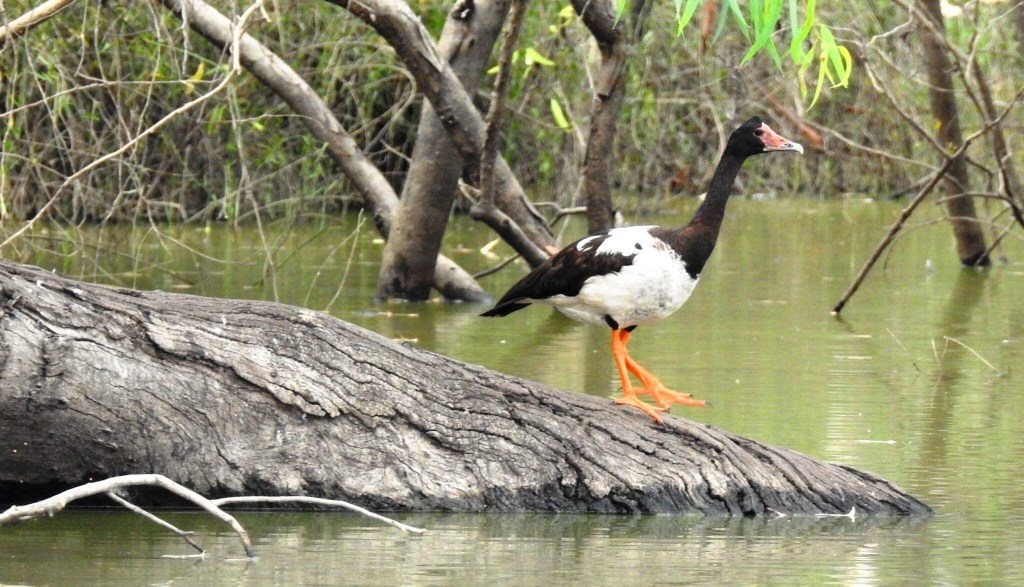
Eddie Vaggs description of this image (The magpie goose. We don’t usually see them in Cargelligo wetlands. But they were here in numbers in 2019 a particularly wet Summer.) Photo courtesy of Craig Cromlin and bureau of meteorology
Looking through my records, I find this email I am now replying to, and your reading of “A Country under the Weather”, with the insightful observation of “a people who knew that no land is won or lost by war”. In today’s moment of constitutional recognition, the assertion that “no land is lost by war” is a positive reminder that Australia has not been lost by a mere 2 centuries of invader wars, not when 2 millennia, 2 decimillennia, more accurately 6 or even 10 decimillennia, have created a civilisation, an exceptional people, with a unique export, a continental civilisation based on peace (peace between peoples and peace with country), as observed by Bruce Pascoe, as well as the transformative “I am responsible for country” (today we need to add: “and planet”).
In many of my Earthsight papers I have included a reminder from ancient wisdom that “insight is the key to creativity”, easily accessible in the simple process of Earthsight Discussion, a term I now use to refer to “Creative Discussion using Plain Pair Groups”, occasionally wondering whether this practice may unfurl the wings of the butterfly of chaos theory.
“Act on Climate” is my latest attempt to make a little suggestion, while “Decimillennial Australia” (earthsight.org, March 2019) indicates who we need to be listening to: the “product of wounded country”, who might even be helped by helping the larger world to actually see.
Decimillennial Australia has probably done this before, recovering from major catastrophes; surely the separation of Tasmania and loss of coastal plains (continental shelf), what we know as the Deluge, was one, and the present ongoing Anglo deluge calls not simply for a Voice to Parliament, but even more, a “voice to the nation”, First People generated and totally independent, arising from creative interaction within multiple communities, which, who knows, might perhaps be facilitated by the “creative ideas (that) ripple out across communities and organisations” of Earthsight Discussion.
Perhaps planetary change can start down along River Road.
Speaking of rivers, I hope you are not being flooded out at the moment. I’ve never driven along River Road, but using Google Earth I can imagine you may be at considerable risk. Murrin Bridge seems to be even more at risk.
On 30 Oct 2019, at 09:43, Edgar Vagg <edvag@me.com> wrote:
Bill.
I met you in Lake Cargelligo at your mother Molly ne Chanter”s funeral memorial service. Was impressed withCreative Discussion using Plain Pair Groups
Bringing Wisdom into Planetary Leadership
The drought and the severe stress created in the Lachlan Valley has brought a small group, Cargelligo Wetlands together. Conventional meetings are still being held and I will eventually bring up your ideas of plain pair groups. At the moment I have another important agenda. To release my book of poems spanning my life experiences in Lake Lake Cargelligo . I’m working on an EPUB for Apple Books of the contents. It’s poems and prose I have written and gathered together over the years . They are mainly environmental. And push the same agenda as you that humans are stupid. I have mentioned your work from
creative discussions.org. I can send you a link for your perusal. It’s a draft at the moment. Created on Pages on an Apple MacBook Pro laptop. I’m aiming to have an impact on citizens attitude towards global warming with its release. At First an E-book with audio readings of the poems on Apple Books and eventually a hard copy with audio included. I’m including a sample poem in audio in a following email.
Edgar Vagg
703 River Road
Lake Cargelligo
NSW
2672
Phone 0428981287
Billy Plains Edict
This his his letter to Decimillennial Australia.
A Voice to the Nation published in Earthsight.org in March 2019
Description of image by Eddie Vagg (Lake Ballyrogan an original ephemeral lake against the Lachlan Range not far from ‘”Atholstane” Bootawa Road where William Plain was raised. It was converted in the 1950s to Lake Brewster water storage linking it to the Lachlan River.)
The already established Anthropocene Mass Extinction, the 6th major extinction, for which the dominant world civilisation is responsible, is now leading us in the direction of exponential global warming and civilisation collapse, or even worse.
We need help, the world needs help, and the urgent need for long-term global sustainability seems to point to First Peoples, and particularly the Australian indigenous civilisation, as among the few who hold the keys to the future. The very long term continuous and highly successful nature of Australian culture and land management over multiple tens of thousands of years means “Decimillennial Australia” needs to establish a “voice to the nation”, to advise on the best way to transform the totality of our civilisation so as to assure that there can be a future. There is a continuum from homo sapiens sapiens to homo stupidens stupidens which englobes whole cultures, entire continents, over centuries and millennia. Ours, the so-called ‘western civilisation’, in many key respects is at the homo stupidens stupidens end of the spectrum.
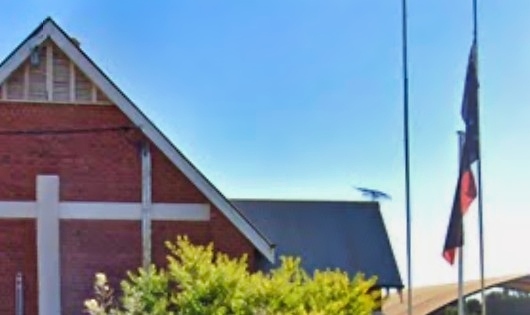
(Francis Xavier School Lake Cargelligo. William plane received a bursary from here to further his education.)
The Australian decimillennial culture in its historical dimension is undoubtedly at the homo sapiens sapiens end. I am inviting those in the indigenous community with ‘access’, to reach back beyond 1788, beyond the two centuries of destruction and belittlement, back into the depths of that culture, and bring forth the knowledge, the wisdom, the essence of 100,000 years of an ever-developing culture, community and responsibility for the earth. Today, this century, that knowledge may well be the key to the future, the key to there being a future. The new Australian culture of two centuries, along with that of much of the present world, is destroying our planet. That’s the meaning of the term, ‘the Anthropocene mass extinction’, which has its origins with the industrial revolution – about the time the doctrine of Terra Nullius arrived on Australian shores.
Caption
(Governor Phillip. “We decided to compromise. We keep the land. The mineral rights. Natural resources. Fishing and timber. And in return we will acknowledge you the traditional owners of it”.)
We don’t realise what we have done, and don’t know how to change. But our problem is now the problem of all peoples, those who have caused the present situation, as well as those who have always worked to contain the damage and respect the planet. It is to be hoped that the most ancient of those wisdom cultures, perhaps the most peaceful and the most responsible, can now become the guide that can advise our leaders and our people – and find ways to lead them to listen and be informed. Looking at the world today, much of the planet is the detritus of the brutality of the Western search for domination and conquest – ever perfected by today’s corporatocracy, financeocracy and oligarchy. The Earth herself is now looking to you, to the people who have tended the earth for 100,000 years, spanning geological catastrophes that today we seek to ignore, while closing our eyes to similar ecological catastrophes we have already created in ‘our’ epoch of the Anthropocene. The 10 millennia that has seen the development of what is now the ‘western civilisation’ that dominates, destroys and is slowly reducing to detritus the major part of the entire world population and its natural diversity evidently do not carry the seeds of wisdom we are desperately in need of today. On the contrary, the 10 decimillennia of Australian civilisation, the peoples who eschewed the deceptive riches of quantity for the wealth of quality, can present the essential understanding that can lead this country, and the entire planet, to a new world, a world of people and planet, rather than a world of profit and power for the few.
We need your assistance to avoid a futurecide that could be worse than the Permian Mass Extinction. The dominant world culture does not have the answer. Any attempt to avoid the risk of exponential warming while using the same technologies and structures that caused it is doomed to failure. We need something new, something ancient, the wisdom and expert knowledge that guided the most successful and sustainable culture and land management of all time, with its respect for life, for community, for country, for planet. There we may find a guarantee of a long-term future for our grandchildren and their grandchildren, and beyond. This process of creating a new world, a world with its origins in so many and varied traditions of sustainable agriculture and supportive communities around the world, would certainly make judicious use of the multitude of non-impactual aspects of the present world; much of our science and technology and culture can be compatible with a ‘planet with a future’. We also need to sustain a deep confidence in the evolutionary direction of the living planet over 4 billion years of dynamic homeostasis, despite the 5 major extinction events to date. We have now initiated the 6th, the first ever where a single species is uniquely responsible. But because we have caused it, through a species-wide reevaluation of our role in the ecosphere, we can initiate a process of fundamental and radical change that can make the world a much better place to live in, for all, and at the same time guarantee a future, for all. The threat of global warming can dissipate by quickly – very quickly – eliminating the causes of the Anthropocene extinction: the excessive human footprint and the carbon overload as well as the massive exploitation of both planetary and human resources.
To do this we certainly need to reevaluate the type of society and economy, the type of leadership, that have developed over centuries, if not longer. The important work of identifying and promulgating the values and the ways-of-being that can help us to draw back from the brink is the most urgent challenge our species has faced.
It seems this type of world that can guarantee that there will be a future has already existed, perhaps in many parts of the world, but on a very long-term continuous basis it has flourished most importantly in Australia. Today such a world desperately needs to be imagined, guided and nurtured into existence by those who have access in the not so distant past to a living culture that can inform our world today. By itself, our world seems incapable of achieving this.
Eddie Vagg.Member of Cargelligo Wetlands and Lakes inc.
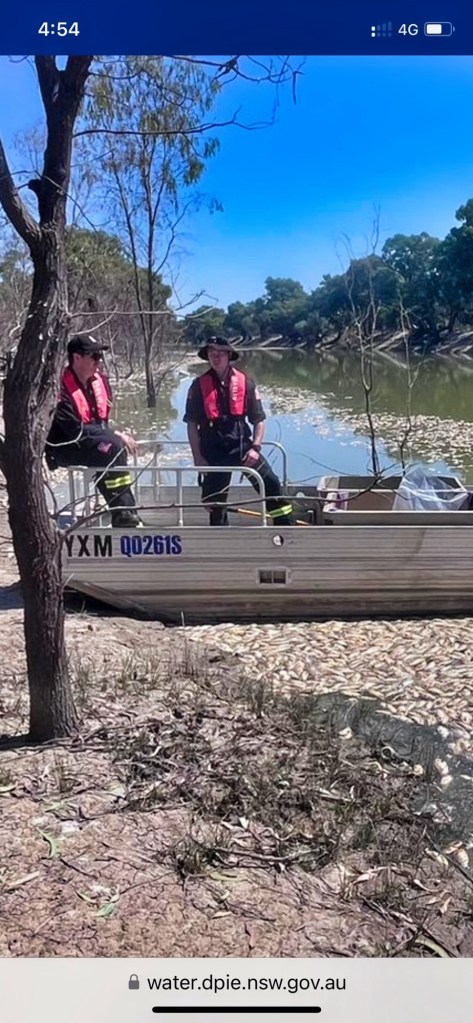
I would also like to acknowledge the Wetlands Warriors in the boat on this cover post. Peter Nilsson and Richie Suckling who have allowed me to use their home turf to explore the Robinson Crusoe island and the extensive Cargelligo Wetlands adjacent to these properties. Photograph by Craig Cromlin
Can we justify. The means of existence. The unbalanced way we disregard all for our own ends. We can and we do despite the evidence to the contrary. We need six planets to sustain our way of life. Then it would still put each planet we invade out of tilter. Because we still haven’t realised the link with every facet of the universe we live in. The chain. The chain of unbroken systems that support all the elements of this amazing planet. The ancient tribes did!.
deep gouged out channels.
drained flood plains.
Bovine belted banks.
No thanks
We can’t deny extraction. That is part of the symbiosis of entities. Every entity relies on something for its existence. It’s the over extraction and destruction of a link that upsets the equilibrium.
I got a plan. The Bureau of Metrology got the wherewithal. Using their regularly updated soil moisture map of Australia. The soil carbon maps of Australia. The saltation studies. The rainfall records.
The northern indigenous tribes have the wherewithall : The reestablishment of native perennial pastures using fire.
My Plan A
The use of GPS collared cattle. The use of Drovers. Remove the fences mental and material.
The wilder beast herds of old in Africa followed the feed across the veldt. And still do.
The bison did the same across America. Their journey ended when they were ere slaughtered by the invaders to starve the Indians out of existence.
The Spanish Shepard’s for thousands of years drove their stock across Spain following the pastures and still do.
Graziers of the Riverina moved their stock to the summer pastures of the high country of the Southern alps. Until they proved a danger to precious bogs.
Kidman the Pastoralist had his properties from northern to southern Australia to take advantage of Northern Rains of summer and the southern rains of winter.
We with modern technology could have our herds follow the feed.
The square paddock mentality for cropping and grazing brought to this great Southland from European conditions. Conditions that even European farmers are finding are destructive. It has to change. Cell grazing would work close to major centres where compost is available to regenerate tired soils.
Saltation of our land and water was held in check by our First Nation people knowingly or unknowingly by the way they used the land and its waters
Our settlers knowingly or unknowingly have left a timebomb . That time bomb was salination. Salt was ubiquitous in the Australian environment. It resides in our marine origin sedimentary rocks and saline ground water. Tree cover. perennial grasses and native farmers kept the system in this variable climate in sync .
It’s not to late to On riverside, log jams and overflows on floodplains maintained wet marshy swamps and billabongs*. This environment kept salt from surfacing. The soggy flood plains refreshed our fresh water streams and aquifers . They remained seeping and weeping through droughts. The rivers scour now freed of log jams. Just a channel for water orders to arrive on time. Bowmaster
A huge study of salt in the environment has been undertaken since European settlement. Today we have the bad news from minister of environment and heritage that this time bomb like land mines is being triggered by our land use and we have to change the way we do things.
While southern Australia shows little shift towards wetter or drier conditions for Autumn 2019 the past two to three decades have seen a decline in autumn rainfall. For example, from 1990, 24 of the 29 years have brought below average rainfall to southeast Australia (below the 1961-1990 average).
In addition to the natural drivers such as the El Niño–Southern Oscillation and the Indian Ocean Dipole, Australian climate patterns are being influenced by the long-term increasing trend in global air and ocean temperatures. SAM a system in the southern ocean is moving our southern fronts further south.
*Peter Andrews (rebuilding wet floodplains)
I can see the answer to disillusionment.
But i dont want to put my finger on it. It feels as if it would alienate me. Isolate me from where i am or imagine i am in my community.
I see the problem and the answer as divisive.
(Excuse me there is a willy wagtail knocking on my window). Oh he’s just picking last nights trapped insects off
the window. One of these days i will learn to communicate with them. (Love their energy.)
I suppose that is my view of the world as a human. Nothing in the cosmos is alien to me. Every thing is a link in the chain. Broken disillusioned people are broken links.
Trauma
I don’t expect any of us from the environment we call lake Cargelligo have anything to do with the trauma that was inflicted on the first people after the first fleet arrived. It’s the present day traumas that are perpetrated. These are the ones we are responsible for, as a people’s . As people’s, we can do something about. Do something about the traumas here and now. If we don’t then we are as guilty as our forebears.The traumas that exist in this community have their roots in natural ecosystems that Lake Cargelligo is so blessed with. Human beings need the natural environment to maintain equilibrium. Every thread of existence every thread of this web every ounce of our being depends on this web.
There’s other ways to pull away from a depressive road. At present too many are falling, crushed by the pressure to conform. Conform is the norm when it comes to violence. It’s normal to bash your partner to be big amongst your mates. Crowing to them that she gets what she deserves. Nailing the perpetrators. Is hard. Jailing the perpetrators is harder. Community unity to change the culture. Destroy the vulture who preys on our mind. We can all write. Express yourself. Honestly write what is depressing you. Write what’s makes you happy. We can put all these community stories together. Put them together on stage in the old theatre to expose our lack of understanding as a community
What to do about the influx of carp after the floods and as it seems forever after
One solution is to eat them
European carp victim of prejudice. Here is why they get a bad rap.
Off-flavour taint of aquaculture products, including around European carp is a global issue reducing consumer confidence in the farmed produce (as well as the wild caught carp of our lakes and rivers). As they are taken up via the gills of fish, and deposited in the lipids (fats) of the animal. If the fish are not purged, resulting undesirable muddy earthy flavour taint can be tasted by consumers. These undesirable flavour and odour is caused by the terpenoid compounds namely geosmin and 2-methylisoborneol, produced as secondary metabolites by certain bacteria including the cyanobacteria and actinomycetes. Geosmin is a neutral oil, with an approximate boiling point of 270 C, which contains carbon and hydrogen, but no nitrogen. It undergoes a reaction with acid (vinegar is an acid) to give odorless geosmin, a neutral oil, with an approximate boiling point of 230 C, which contains only carbon and hydrogen. 2-methylisoborneol, is also reduces to an odorless compound with acid
A study on the reduction of off-flavour compounds that cause “earthy” and “musty” organoleptic sensorial characteristic in fresh water systems was conducted. These compounds include geosmin and 2-methylisoborneol (MIB), which are produced as metabolites by some algal and bacterial species. Drinking water and aquaculture commodities affected by these compounds become undesirable to consumers, and market values tend to drop significantly. Triple distilled water samples spiked with approximately 1 μg Kg-1 geosmin and 1 μg Kg-1 2-methylisoborneol were dehydrated through acidification using two different food grade organic acids (acetic and citric acid), at different concentrations: 0.1, 1.0 and 4.0% (w/w). Levels of geosmin and MIB reduction were determined using Solid Phase Microextraction (SPME) and Gas Chromatographic/Mass Spectroscopic (GCMS) analyses. Results showed that acidification treatments of the off-flavour compounds using varying concentrations of acetic and citric acids significantly reduced the concentrations of geosmin and MIB in the samples. Treatments with 1.0% citric acid and 4.0% acetic acid significantly reduced the concentration of geosmin to concentrations as low as 0.07±0.03 and 0.09±0.01 μg Kg-1 respectively, while the reduction of MIB to concentrations of around 0.05±0.01 μg Kg-1 was achieved at a minimum concentration of 0.1% of either acid used. Previous studies reported that products of the dehydration process of geosmin and MIB produce non-odourous products such as argosmin, and 2-methylenebornane and 1-methylcamphene respectively.
Armed with this kind of knowledge, we can begin a journey to reduce the impact of carp in our waterways by putting a dent in their population, and start educating the public on how to eat them. They do it in the northern hemisphere. Treating them like repulsive vermin has put up a wall of ingrained prejudice, so deep in our Aussie culture and it will be hard to overcome.
This tells us that the expansion & creation of companies like Charlie Carp and K&C Global ( Keith Bell) Fisheries could utilize more of the Carp biomass & at the same time reduce the amount of Chemical fertilizers used on farms & in homes, which vastly affect the health of our waterways when run offs occur after rain.
If the Koi Herpes Virus is released then it is very possible that this will no longer be an option.
Keith Bell, the fisherman who is responsible for almost all the Carp exported from the country in the last two decades, states that once the Carp begins rotting, it can’t be used for either pet food or fertiliser. He says that even if the fish could be collected in time (a matter of hours after dying), the volume would probably overwhelm processing facilities. Carp isn’t being used for pet food at the moment and the fertiliser industry only processes a couple of hundred tonnes per year, according to Keith.
Now if we are to utilize Carp for Fertilizer on a larger scale this will also increase the need for Commercial Fishing Operators to catch them.
This leads me to my next point – Commercial Fishing & Export. Currently there appears to be no export of Carp. That does not mean the demand is not there for it. Keith Bell was exporting thousands of tonnes of Carp every year until 2015 when he sold up & moved overseas. This was because the drought reduced his catch numbers to become unviable
Keith, who was exporting a couple of thousand tonnes of Carp per year from Australia from the late 90’s until 2016, when he sold up & moved to Mississippi. In the article “Weaponising Herpes – What could possibly go wrong with Carpageddon?” he was further quoted in saying “It’s a wasted resource” & said that restrictions placed on what equipment he could use to catch the fish & restrictions to minimise the bycatch of native fish, made fishing Carp too expensive. By relaxing some of these restrictions on commercial fishing, it could possibly boost the export of Carp.
Carp can be very tolerant of air exposure and can live for prolonged periods in ice slurrys. To maximise their eating qualities they should be killed humanely by iki jime, or a firm knock to the head before being placed in an ice slurry after bleeding.
Fish Description:
European Carp have small eyes, thick lips with two barbels at each corner of the mouth, large scales and strongly serrated spines in the dorsal and anal fins.
The colour is variable depending on water conditions, but is commonly olive green to grey dorsally, fading to silvery yellow on the belly.
Fish Distribution:
Carp are actually native to Asia, but ancient traders are thought to have spread the fish west into Europe.
From there carp have been introduced into Australia on several different occasions. European carp have been introduced into the Murray-Darling system as well as many other water bodies and rivers in south eastern Australia.
Small populations also occur in Tasmania and Western Australia.
They also have been translocated into many other countries and are now one of the most widely distributed freshwater fishes in the world.
Fish Size Common Length:
40-50 cm, maximum size exceeds 120 cm and 60 kg.
For assistance with identifying fishes, see fishesofaustralia.net.au. For information on size and bag limits, check out the website of your State Fisheries Department. We thank fishesofaustralia.net.au and Australia’s various Fisheries Departments for some of the thumbnail images used to assist with fish identification on this website and its applications, as licensed for use under Creative Commons Attribution 3.0 Australia. Thanks also to Michigan State University and Georgia Aquarium for generous donation of xrays of some US fish species.
What Is Ike Jime?
Ever wonder why yellowtail or bluefin sashimi tastes better at a truly authentic sushi bar? You’ve probably brought fish home from a trip and created your own sashimi platter only to discover it didn’t quite taste the same and the texture wasn’t as nice as what you’re accustomed to ordering at your favorite Japanese restaurant. You just harvested the fish yesterday – it doesn’t get any fresher, so what gives? The way a fish is handled once it comes aboard is what truly makes the difference in terms of taste and quality. Welcome to Ike Jime. Follow this simple four-part process and you will enjoy an elevated caliber of fish at home or on the back of your boat.
The finest quality seafood is often associated with sashimi, sushi, and other Japanese raw fish preparations. Ike jime is a traditional Japanese slaughter technique that involves instantaneously euthanizing a fish by inserting a spike into its brain cavity. The fish is then thoroughly bled and undergoes spinal cord destruction (shinkei jime) before getting iced down.
Why Is Ike Jime Important?
Ike jime produces a biochemically superior grade seafood product as the process helps to eliminate stress and the natural consequences of death. When a fish experiences stress, its brain goes to work by flooding the muscles with lactic acid, cortisol, and adrenaline. Core body temperature also rises. The combination of hormones and elevated temperature turns muscle tissue to mush and negatively impacts taste. When performed correctly, ike jime prevents this from occurring.
The following four steps will yield tremendous results. When performed correctly, you will notice not only a better tasting fish but a fish that will last longer. The term “fresh” is commonly used by grocery stores to convince you to buy their imported fish. A properly processed fish will stay “fresh” significantly longer. Harvested with the ike jime method, fish can be refrigerated for weeks when safely stored in a vacuum sealed bag or airtight container. This process not only makes the fish taste better – it also lasts longer, has zero smell, and reduces waste as it won’t spoil nearly as fast, allowing you to respect the fish and the fishery to the maximum ability.
After rejecting outright asphyxiation for being cruel, and clubbing the fish by hand for being inefficient and easy to mess up, the institute (the Institute of acquelculture in Shepherdstown West Virginia landed on automated stunners from Seafood Inovations in Australia, which they’ve been using ever since.
There’s plenty of evidence that killing fish with a blow to the head results in better food. But Tsui wanted to see if using the full ike jime process, including spinal cord destruction, made a significant difference. There were slight differences immediately after death, but a few days after slaughter, the color, texture, and pH levels were about the same, suggesting that a quick, calm death is the most important route to high-grade fish.
Fish for eating we have people to eat them all cooks are there to make fish palatable you should not be a cook unless you can. Soak them in vinegar 50 50 with water overnight removes the unpleasant taste.
European Carp a no different.
the fish have to go. Eat them as roe . Even the mail gonads make a dish if that’s what you wish.
Extracts from oxley’s diary as he passed through Lake cargelligo. Extracts from his observations made in Guttenberg Press publication of his daily diaries as he came down and up the Lachlan. in 1817.
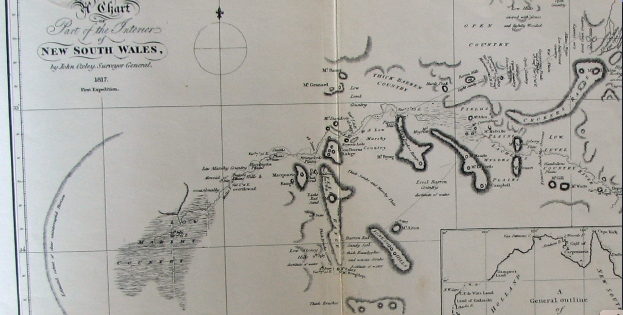
Oxleys map is a part sketch of the area bounded by the Northys Hills in the west and Sansons Hills in the east. The Lachlan River runs from the north-east to the west. Smalls Lake and Lake Cargelligo are circled in. Smalls Lake is Campbells Lake and Lake Cargelligo is Regents Lake. Northys Hills is the Goulburn Range. Mount Bing is Sansons Hills to the east of the Lachlan Range. Notice he has called all that area between “low marshy country”.
I’m posting this to reinforce the fact oh how depleted Lachlan Valley has become after colonisation.
Oxleys diary July 23, 1817 :
The river had fallen a little during the night. At nine o’clock we again set forward: the country became extremely low and marshy, far more so than any we had passed over east of Macquarie’s Range.(Lachlan) These marshes extended so far southerly that to have gone round them would have led us far from our purposed course without answering any useful purpose, and although we judged that at first they might not extend above three or four miles back, yet we soon had reason to change that opinion. The river had led us upon a general course nearly east about six miles, when about half a mile from the bank southerly, a very extensive lake was formed, extending about east-south-east and west-north-west from three to four miles, and being about a mile and a half wide. Excepting the sheet of water on the north side near the termination of the stream, this was the only one we had seen that could justly be entitled to the denomination of lake. We crossed over a low wet swamp, by which its overflowings are doubtless re-conveyed to the river. This lake was joined to another more easterly, but much smaller. We could not form any correct judgment how far the marshy ground extended south-east of it; but the country was low and level as far as Mount Byng, and a low range extended north-easterly from it. We now kept the banks of the stream, till at the tenth mile we ascended a small hill a mile south of it, from which Mount Byng(a hill somewhere between Lake Cargelligo and Tullibigeal) bore N. 12. E. Close under the hill ran a considerable branch of the river, which certainly supplied the lakes and lower grounds with water; on the other side of this arm, the country was low, and apparently marshy as far as we could see. On examination I found it would be extremely difficult to cross this branch, as the water was too shallow to swim the horses over, and the ground so soft that they could not approach the banks within several yards. I therefore determined to get upon the river nearly where this branch separated from it, and endeavour to construct a bridge, by which we might convey the provisions and baggage over: as to the horses, they could easily swim across.
The course of the river during the day had been nearly due east, but from the separation of the branch it seemed to take a more northerly direction; the banks were very low, and never exceeded five feet from the water. Occasional points of land somewhat more elevated than the general surface would of course make them in Places a little higher; but we could not discover any marks which denoted a greater rise than six feet, or six feet six inches, above the present level. When we halted in the evening, the stream was running with great rapidity. The water did not appear to have either risen or fallen during the day; but all the trees which would have best answered our purposes were now several feet in the water. We had however no alternative but to cross somewhere in this neighbourhood, as we were fearful of entangling ourselves in marshy ground by proceeding farther up this bank; and to attempt to penetrate, or even to round, the marshes to the southward, (if it were practicable,) would take up more time (without being of any service) than we could spare. Experience had made us too well acquainted with the nature of these marshes to run any needless risks; and we had besides great hopes that we should find better travelling to the northward, which as the river seemed inclined to come from that point would also be a great convenience to us, as I did not purpose to quit its banks as long as it continued to run any thing north of east.
As to the soil and general description of country passed over this day, the low-lands were all swamps covered with atriplex bushes, and where the land was a little more elevated, the soil was sandy and barren, covered with acacias, dodonaeae, small cypresses and dwarf box-trees. Our course was E. 4. N. 6¾ miles; but by the windings of the river, we had measured nearly 12 miles. The lake I named Campbell Lake (Smalls Lake), in honour of Mrs. Macquarie’s family name.
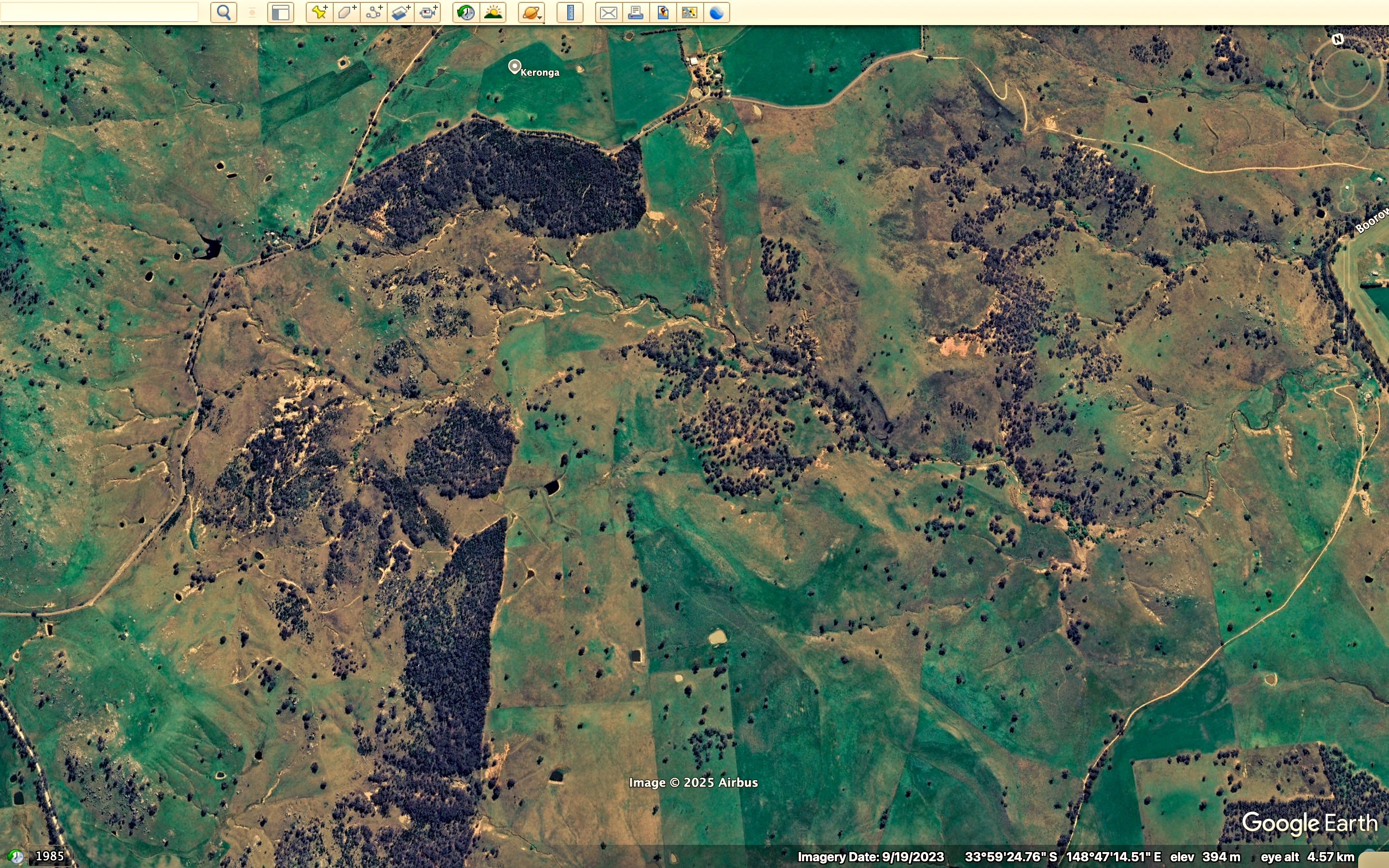
This Google Earth screenshot is the present day aerial view of the country Oxley is describing in his daily diaries of the 23rd and 24th of July 1817
July 24.—At day-light we attempted to construct our bridge near to the place where we were encamped, but as fast as the trees were felled they were swept away by the rapidity of the current; the breadth on an average being now, by reason of the flood, nearly sixty feet, and the trees on the immediate or proper banks being several feet in the water: we were therefore obliged to fell trees farther inland, and these, as before remarked, were swept away, falling short of the land on the opposite side.
All our attempts to construct a bridge during the day were fruitless, as the flood was too violent to allow the trees to take firm hold: in searching the banks of the stream for a proper place for our purpose, an arm nearly as large as the main branch up which we had travelled was discovered about a mile down the stream on the north side; it ran to the north-north-west, and then apparently trended more westerly. Thus is this vast body of water, all originating in the Eastern or Blue Mountains, conveyed over these extensive marshes, rendering uninhabitable a tract which they might reasonably be expected to fertilize.
Finding that in the present high state of the water we could not succeed in crossing the river, at least near our present station, and that if we returned lower down we should experience a farther difficulty in crossing the north-west arm recently seen, it was judged best to try if we could get over the branch on the south side, and swim the horses over in the main stream near the mouth of the branch. We could not, however, find any tree on this side that would reach across; although it was quite dark before we gave over the attempt for the night.
Oxley’s own map of his journey down the Lachlan 1817. The journey began at Cowra. He was blocked at Gemalong near Forbes on his way down. Was heading back to the sea in the south to hitch a ride back to Sydney. Turned around again near the present day Griffith went north to find Lachlan again. Proceeded down stream to Booligal then returned again past Lake Cargelligo. Crossed the river near Kiacatoo went back to the Macquarie and made his way back to Bathurst from there.
July 25.—Every means was again employed in constructing the bridge over the south-west branch. The stream had fallen but a few inches, and continues to fall too slowly to permit us to entertain any hopes of crossing it in this vicinity.
Our bridge was finished by one o’clock, but it being too late to cross the horses and baggage this evening, I went in company with Byrne on horseback to view the country to the southward. After going about two miles and a quarter south of the tent, we were most agreeably surprised with the sight of a very fine lake( Lake Cargelligo); we rode down to its shores, which on this side were hard and sandy beaches. On the south side the shores were bolder, being red clay cliffs. We now found that the creek or arm which I had supposed to be the source whence Campbell Lake( Smalls Lake) was supplied, had not any communication with it, but supplied the lake we now saw: a low ridge of hills, bare of trees except small cypresses in clumps, lying between the two lakes, which were distant from each other two or three miles. Finding I might obtain a better view by going to the point of these bare hills about five miles westward, I rode thither along the margin of the lake, but quitted it to ascend the hill, which was about two miles and a half from it. The hill was but low in comparison with Goulburn’s Range. Northeys HIlls) and other hills in the vicinity, but was sufficiently elevated to afford me the most varied and noble prospect I had seen in New South Wales The expanse of water was too large and winding to be seen in one point of view, but it broke in large sheets from east to west for upwards of six miles; its medium breadth being from two and a half to three miles: it was bounded six or seven miles from its eastern extremity by a low range of hills connected with Mount Byng (Sansons Hills), and from the dark broken woody appearance of the country in that direction, I felt assured that the stream came from a more northerly quarter. To the westward was Goulburn’s Range,(Northeys Hills) distant about five or six miles; its bold rocky peaks of lofty elevation forming a striking contrast to the dead level of the country southerly, in which however Mount Aiton(perhaps IllawongHills) appeared like a blue speck on the horizon. To the northward was Mount Granard, the highest of a very elevated range, it having been seen at a distance of seventy-two miles from Mount Aiton; and to the north-north-east were extensive open flats; in one place, bearing N. 17. E., I thought I could distinguish water. Between the hill on which I stood and the stream, Campbell Lake (Smalls Lake) wound along the plain, but its width did not allow it to be so conspicuously seen as the present one. To the south-east and round to the north-east the country was covered with dark foliage of the eucalyptus, intermixed with the cypress; whilst to the south-west, as far as the base of Goulburn’s Range (Northeys hills), it was more open, with gentle hills clothed with a few small cypresses. These hills were rocky and barren, the lower grounds a red loamy clay; but the intermingled light and shade formed by the different description of trees and shrubs, the hills, but above all, the noble lake before me, gave a character to the scenery highly picturesque and pleasing.
From this eminence I took the following bearings to objects connected in the survey, viz.The highest point of Goulburn’s Range N. 225 degrees distance 5 or 6
miles.
Do. Do. Mount Aiton 143
Table Hill 116
Mount Byng 114
West extreme of the lake N. 106. 30. distance 2½ miles.
East Do. Do. N. 65. distance 5 or 6 miles
Highest point of Mount Granard N. 341
Extremes of extensive flats from N. 346½ to N. 10. distance













 CargelligoWetlands